A gym plan that fits your body, built from your body scan
- Fitness
- Body Composition
- Strength Training
- Knee Care
- Calculator
Note: This is general guidance for learning, not medical advice. If you have a health problem, or haven't been active for a long time, see a doctor before you start.
A body scan sheet shows more than your weight. It shows how much is fat, how much is muscle, and where. This post turns that sheet into a gym plan: 2 to 4 short days a week, kind to your joints.
You can follow the plan for two made-up people, a woman and a man. Then try the calculator with the example man, the example woman, or your own numbers.
Why one plan doesn't fit all #
Two people can weigh the same and need different plans. One carries more fat. The other has less muscle in the legs.
A body composition scan (a scale that sends a tiny current through you) splits your weight into fat and lean mass. Lean mass is muscle, water and bone. Many scans also show each arm, each leg and the trunk.
Our two made-up examples:
| Example woman | Example man | |
|---|---|---|
| Age, height | 34, 160 cm | 38, 172 cm |
| Weight | 68 kg | 76.4 kg |
| Body fat | 38 % | 31.5 % |
| Fat-free mass (all but fat) | 42.2 kg | 52.3 kg |
| Weak spot on the scan | Both legs | Both legs and the left arm |
How the plan is built #
The plan comes from your sheet in five steps:
- Scan: read the numbers on your body sheet.
- Targets: work out the fat to lose and the muscle to gain.
- Week: pick 2, 3 or 4 gym days.
- Workouts: A and B sessions, with a swap for every move.
- Check-in: weigh each week, scan again, then start over with the new numbers.
Pick your options #
The calculator fills what it can from your sheet. You pick the rest.
| Option | Choices |
|---|---|
| Body formulas use | Female or male (what the scanner used), or prefer not to say |
| Show exercises on | A female, male or neutral figure |
| Goal | Lose fat, both (lose fat and build muscle), stay as you are, build muscle |
| Level | New to the gym, returning after a break, trained for 6 months or more |
| Days a week | 2, 3 or 4 |
| Where | Gym, home with dumbbells, home with no equipment |
| Joints to care for | Knee, lower back, shoulder, or none |
The exercises, sets and rules are the same for everyone. Only the healthy ranges, the notes and the pictures change.
Your numbers #
Here are both examples. Each is on their feet most of the day, wants to lose fat at a steady pace, and eats standard protein.
She trains 45 minutes 3 times a week. He trains 45 minutes 4 times a week.
| Example woman | Example man | |
|---|---|---|
| BMR (energy at rest), from the sheet | 1,282 kcal | 1,500 kcal |
| Daily energy use | 1,870 kcal | 2,230 kcal |
| Calorie target | 1,410 kcal | 1,680 kcal |
| Protein | 73 g a day | 107 g a day |
| Target weight | 60.7 kg | 66.8 kg |
| Fat to lose | 8.8 kg | 12 kg |
| Time to target | about 21 weeks (21 to 35) | about 24 weeks (24 to 48) |
How each number is worked out, in one line each:
- BMR: the number printed on your sheet. Without it, Katch–McArdle: 370 + 21.6 × fat-free mass.
- Daily life: BMR × 1.375 for "on your feet" (1.2 desk, 1.55 active, 1.725 very active).
- Exercise: 5 MET (a measure of effort) × weight × hours a week ÷ 7. For him: 164 kcal a day.
- The gap: pace × 7,700 kcal per kg ÷ 7. At 0.5 kg a week, that's 550 kcal.
- Limits: the gap is never more than 25% of your daily use. Her gap is cut to 460 kcal, so her pace drops to 0.43 kg a week.
- Protein: 1.2 to 1.6 g per kg of target weight. You get the top from 150 minutes of exercise a week: he does 180 (107 g), she does 135 (73 g).
The weeks in brackets run from the faster pace to the gentle one. Real loss slows as weight drops, so treat them as a guide.
See these numbers in the calculator, or start with your own.
Your week #
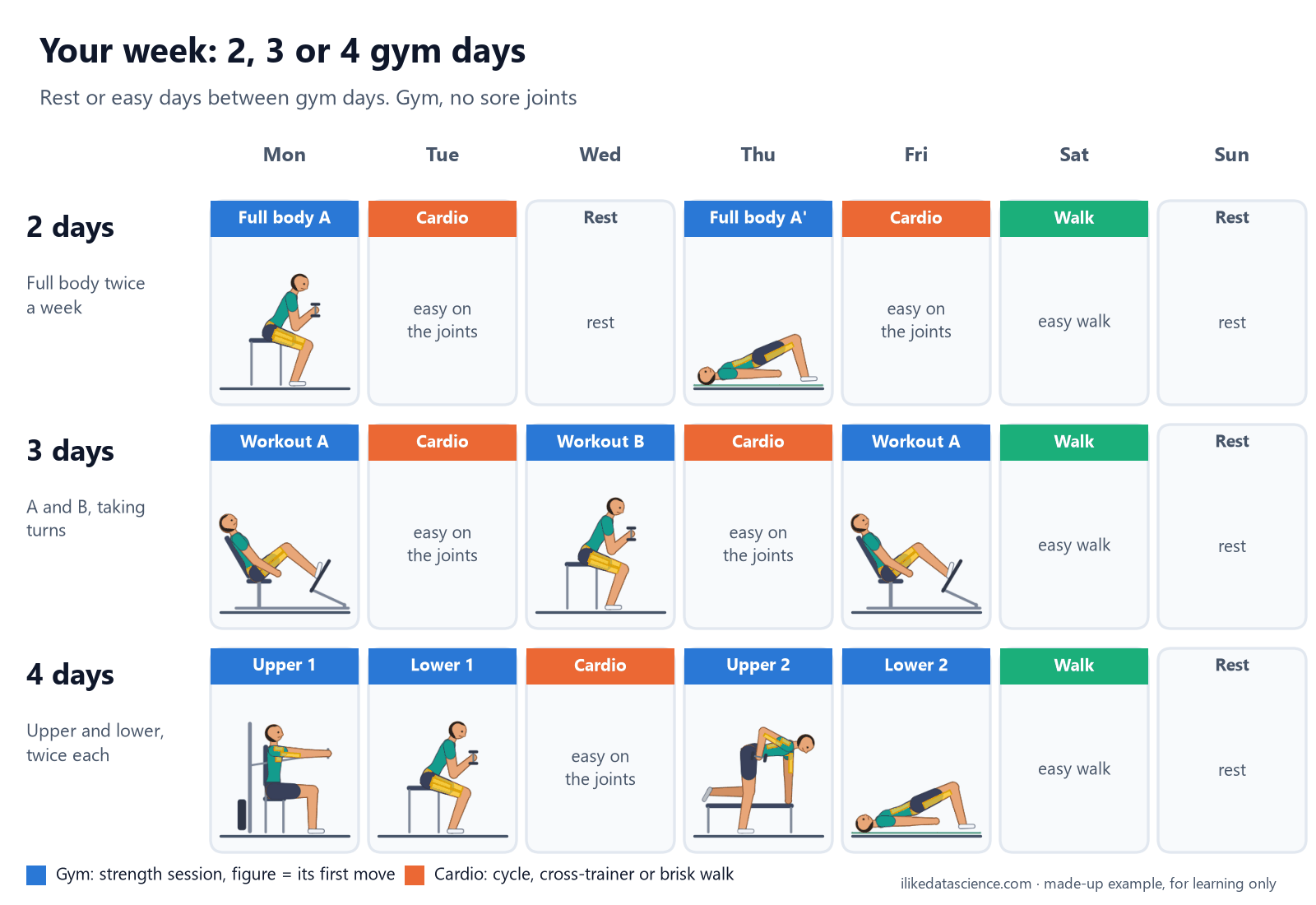
The plan has 2, 3 or 4 gym days. Each gym day has a rest or easy day after it, or works other muscles.
| Day | 2 days | 3 days (the woman) | 4 days (the man) |
|---|---|---|---|
| Mon | Full body | Workout A | Upper 1 |
| Tue | Cardio | Cardio | Lower 1 |
| Wed | Rest | Workout B | Cardio |
| Thu | Full body | Cardio | Upper 2 |
| Fri | Cardio | Workout A | Lower 2 |
| Sat | Easy walk | Easy walk | Easy walk |
| Sun | Rest | Rest | Rest |
With 3 days, A and B take turns. Week 1 is A B A. Week 2 is B A B.
The rules for every session #
- Pick a weight that leaves 2 to 3 reps "in reserve". At the end of a set, you could do 2 or 3 more.
- Tempo: 2 seconds down, 1 second up.
- Rest 60 to 90 seconds between sets.
- Add weight (1 to 2.5 kg) after two sessions that felt easy at the top of the rep range.
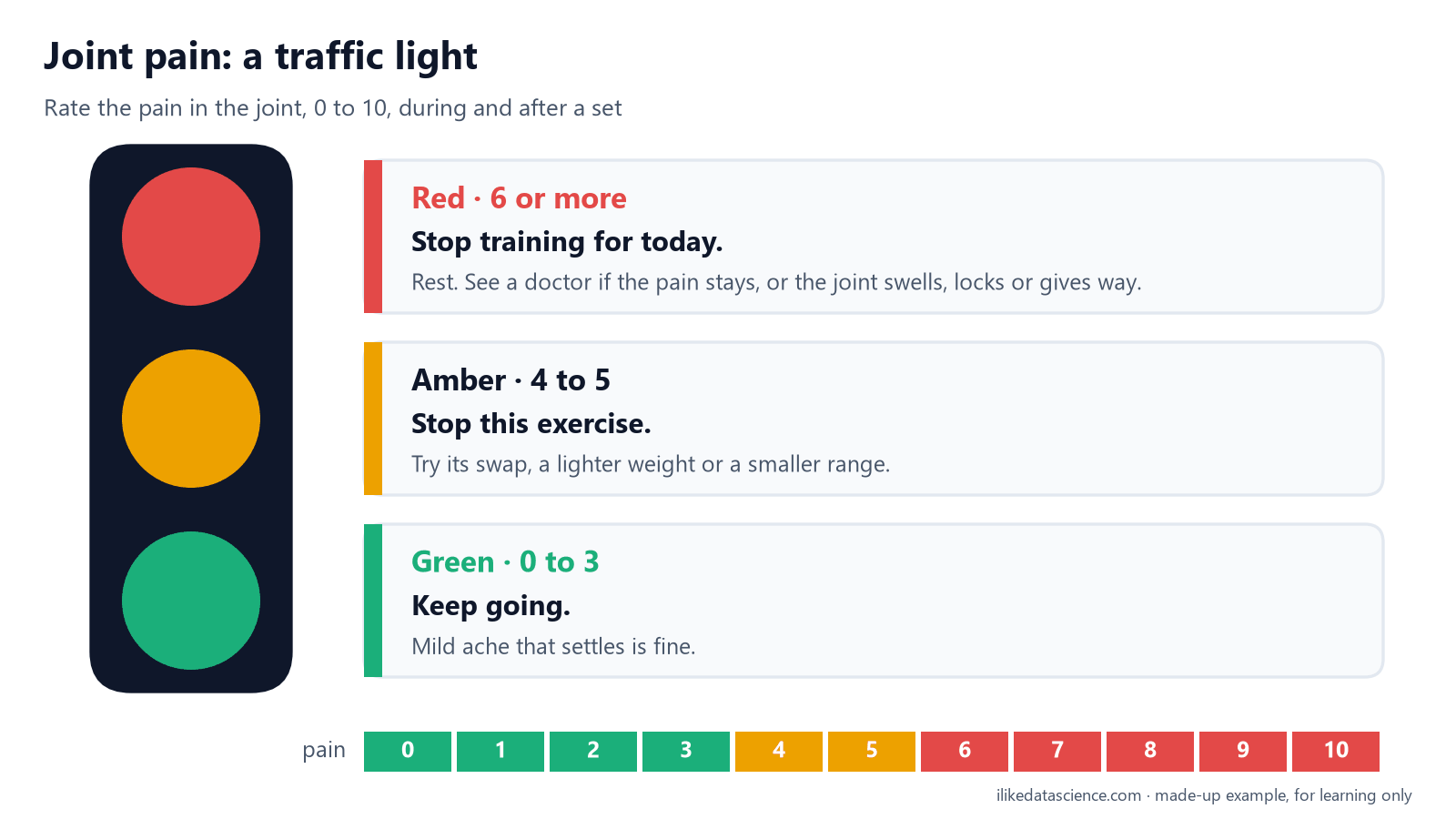
- Stop an exercise if joint pain goes above 3 out of 10.
Workout A and B #
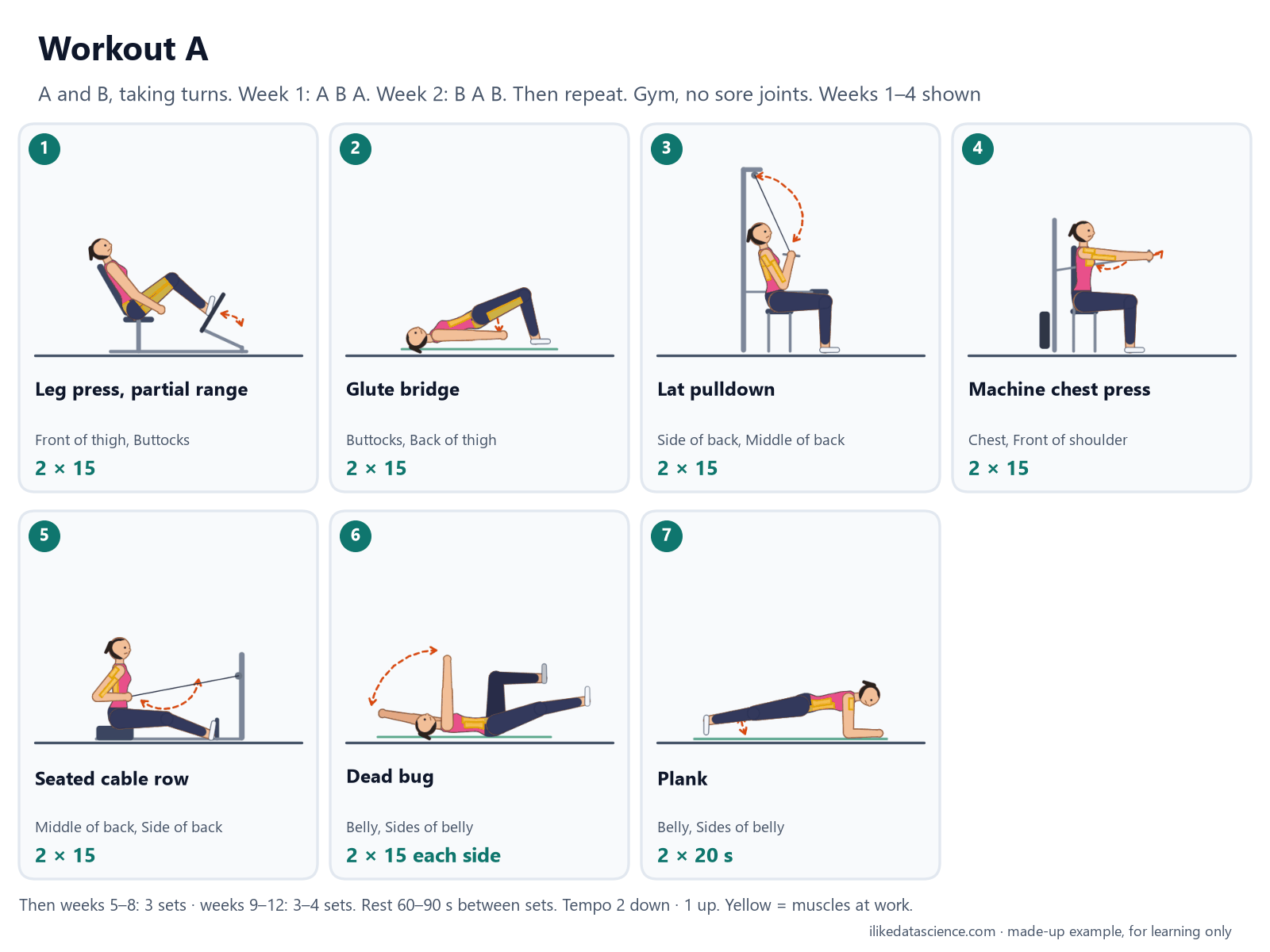
These are the 3-day sessions, with the woman's picks. In weeks 1 to 4, do 2 sets of 15, or hold for 20 seconds.
Workout A
| Exercise | Main muscles | Weeks 1 to 4 |
|---|---|---|
| Leg press, partial range | Front of thigh, buttocks | 2 × 15 |
| Glute bridge | Buttocks, back of thigh | 2 × 15 |
| Lat pulldown | Side of back | 2 × 15 |
| Machine chest press | Chest, back of upper arm | 2 × 15 |
| Seated cable row | Middle of back | 2 × 15 |
| Dead bug | Belly | 2 × 15 each side |
| Plank | Belly | 2 × 20 s |
| Seated leg curl (extra, for her legs) | Back of thigh | 2 × 15 |
Workout B
| Exercise | Main muscles | Weeks 1 to 4 |
|---|---|---|
| Box squat to a bench | Front of thigh, buttocks | 2 × 15 |
| Seated leg curl | Back of thigh | 2 × 15 |
| Dumbbell Romanian deadlift | Back of thigh, buttocks | 2 × 15 |
| Seated dumbbell shoulder press | Shoulders | 2 × 15 |
| One-arm dumbbell row | Side of back | 2 × 15 each side |
| Incline push-up | Chest | 2 × 15 |
| Side-lying leg raise | Side of hip | 2 × 15 each side |
| Side plank (knees bent) | Sides of belly | 2 × 20 s each side |
| Slider leg curl (extra, for her legs) | Back of thigh | 2 × 15 |
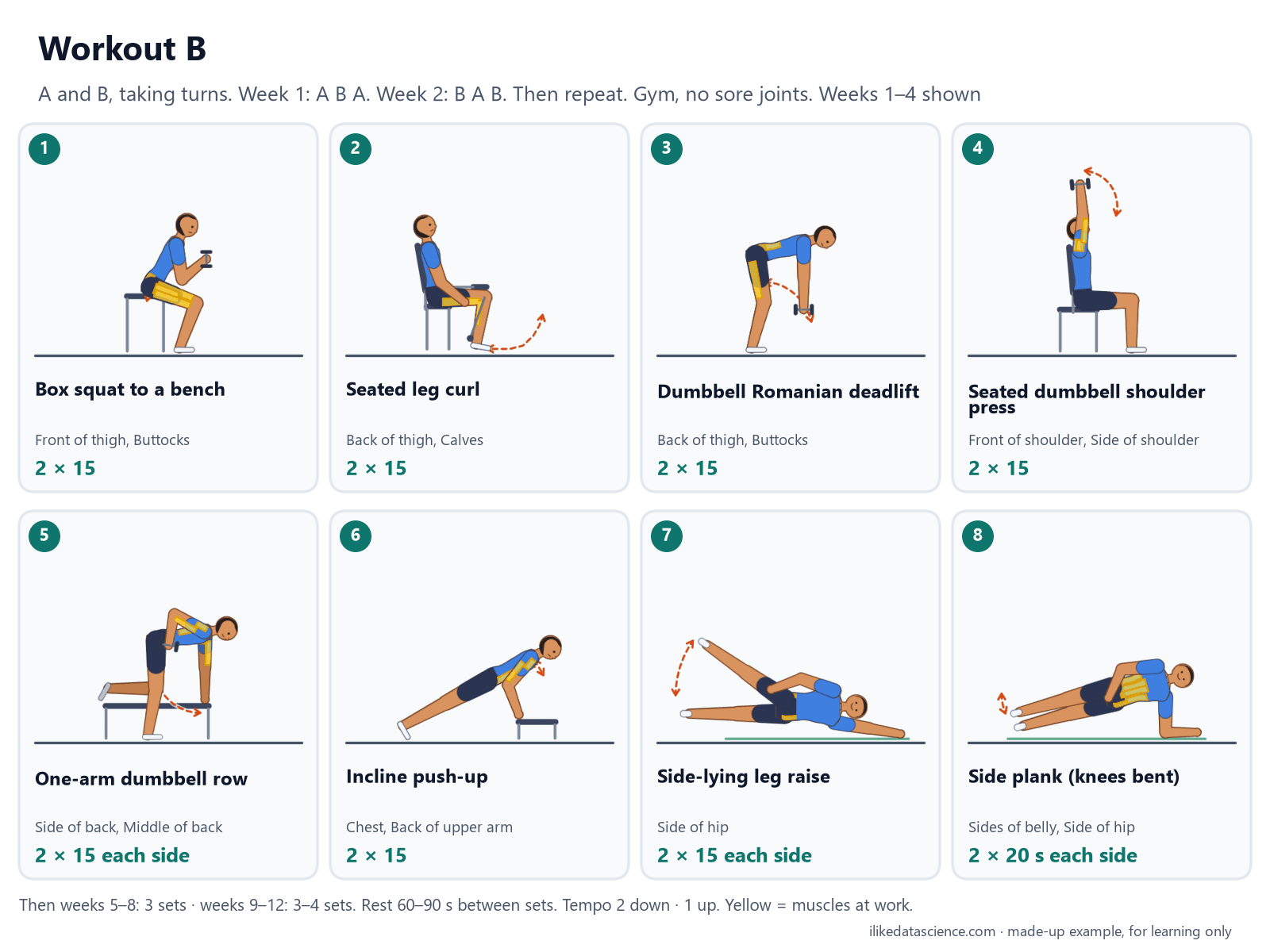
The man's 4-day plan uses the same moves, split into upper and lower days. His left arm is weaker by 9 %, so one-arm work starts with the left side.
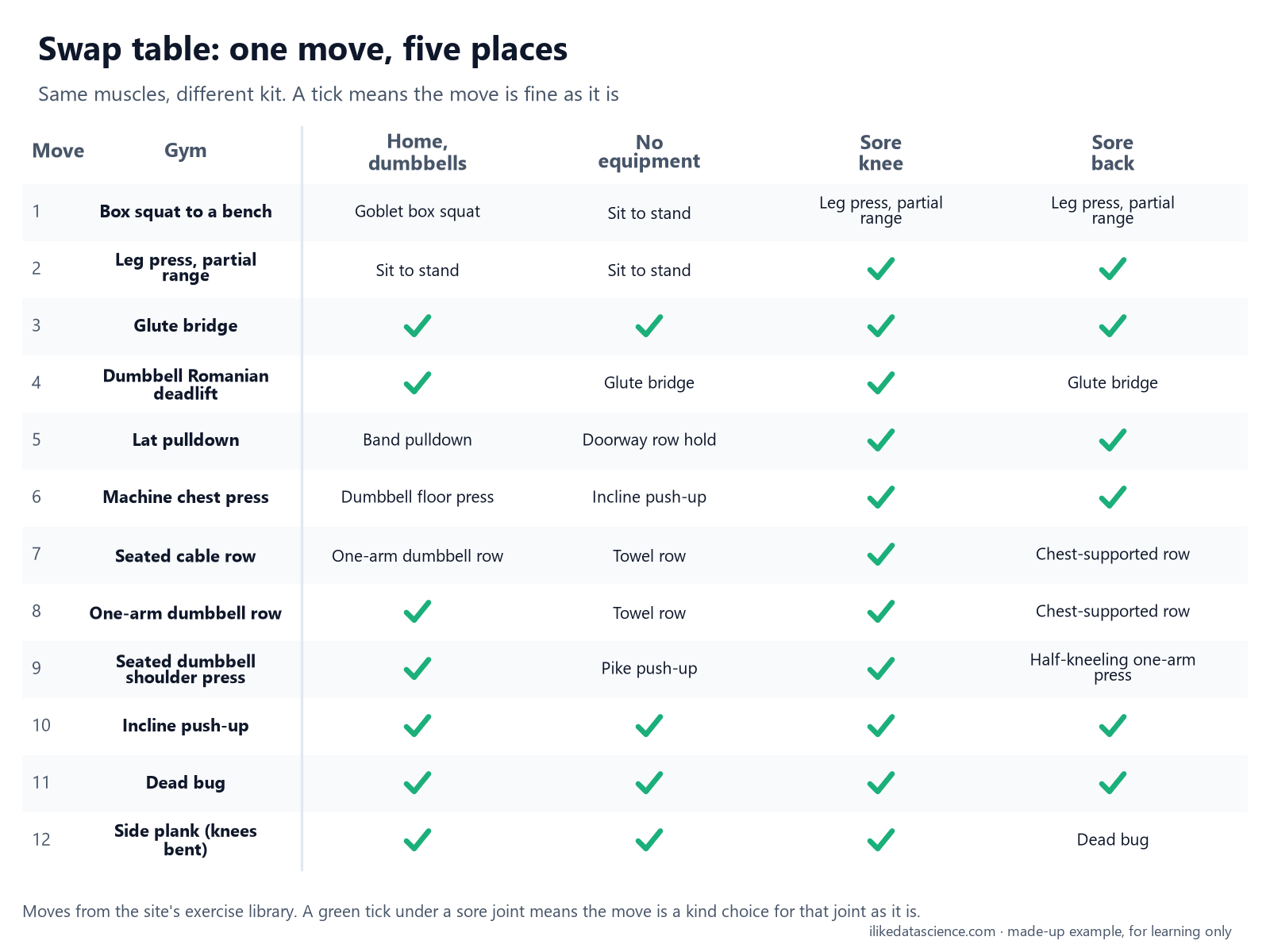
No machine, or a sore joint? Every move has a swap that works the same muscles.
How to do the key moves #
Each loop shows the move. Breathe out as you push or pull.
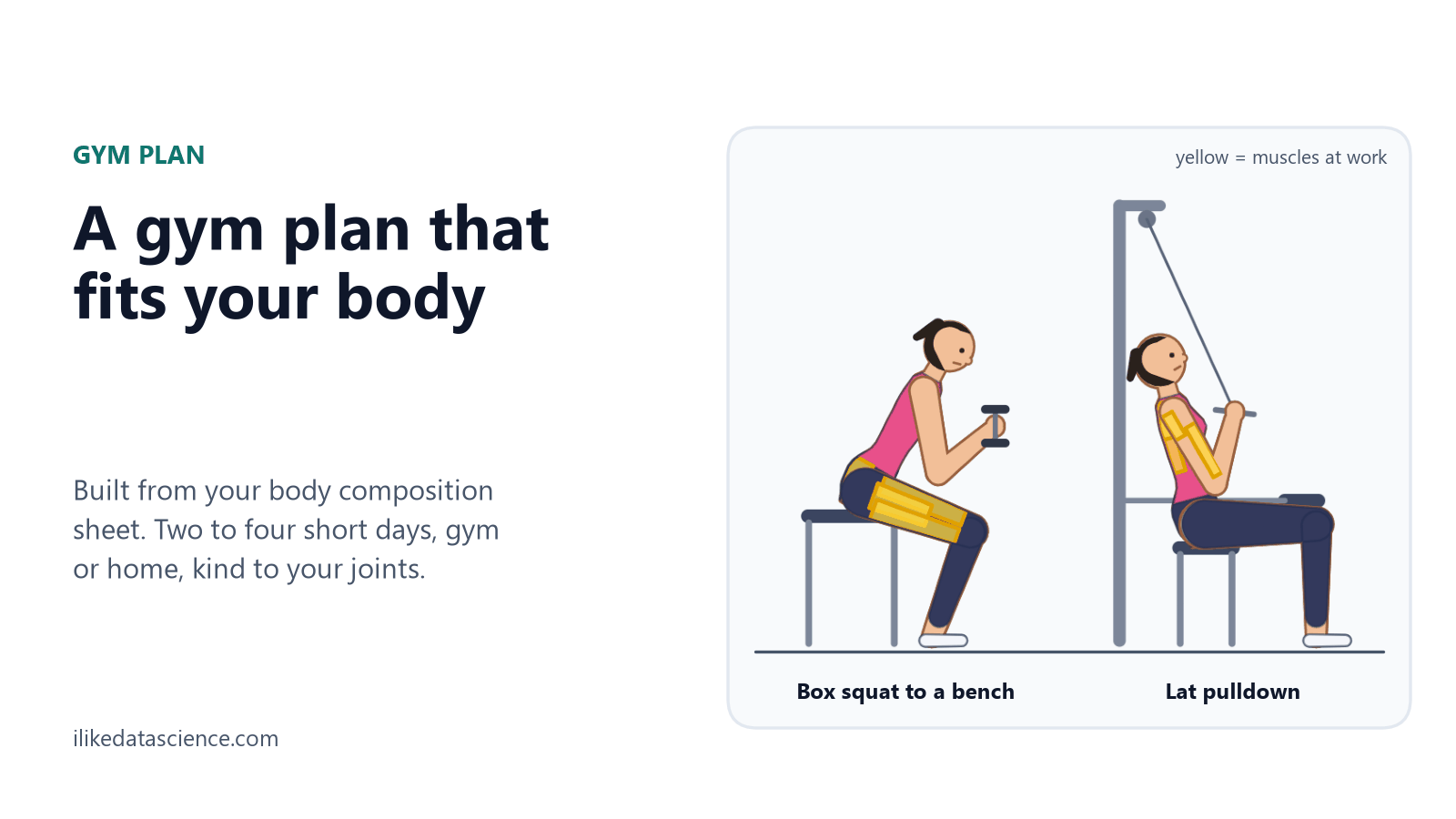
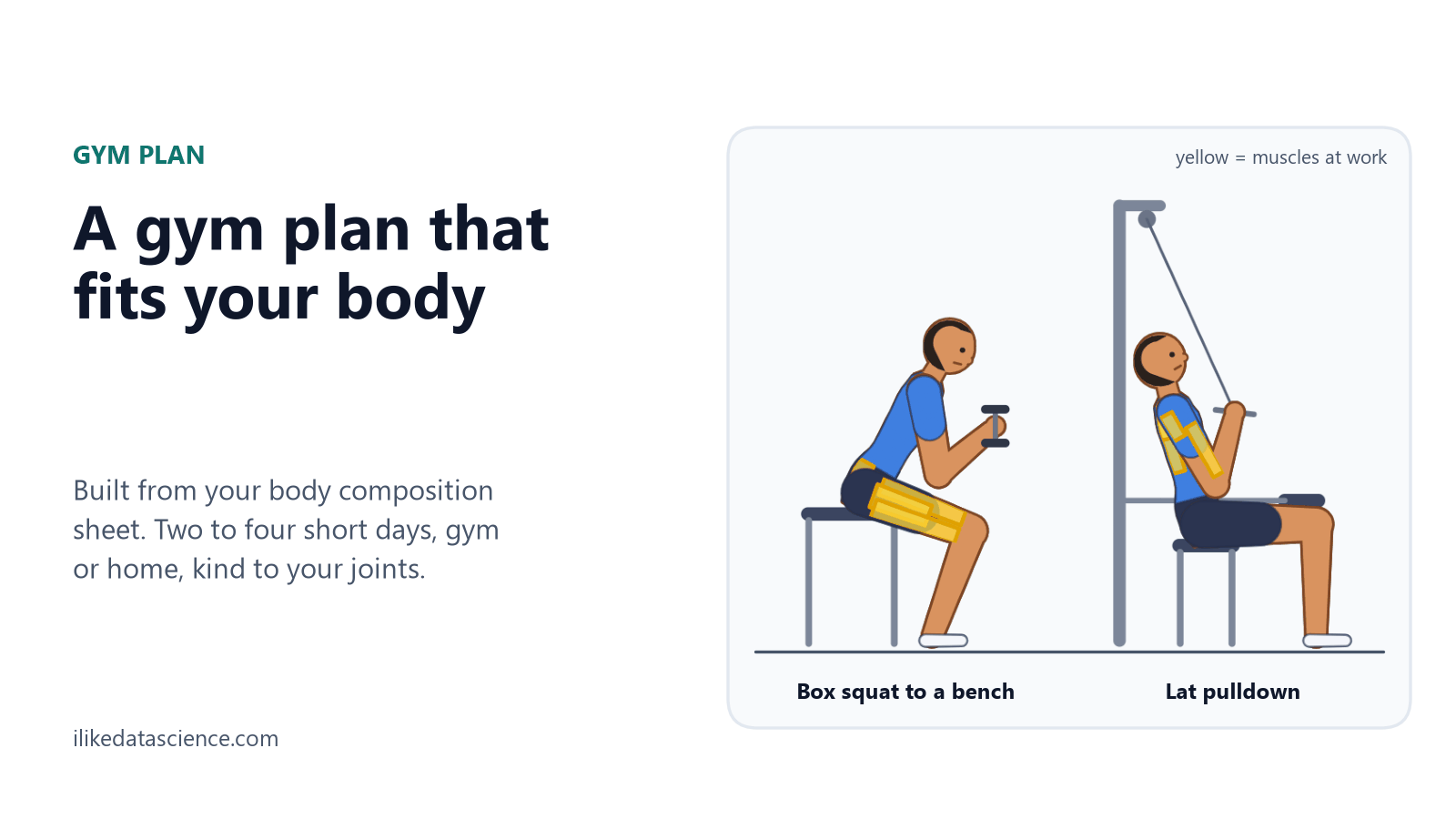
Box squat to a bench #
- Stand in front of a bench, feet a little wider than your hips. Hold one dumbbell at your chest.
- Push your hips back and bend your knees. Sit down slowly until you touch the bench.
- Keep your chest up. Push through your whole foot to stand up.
Watch out: dropping onto the bench instead of touching it lightly. Source: Muscle & Strength
Leg press, partial range #
- Sit with your back and hips flat on the pad. Put your feet hip-width apart on the plate.
- Bend your knees slowly, only as far as feels easy, about a right angle at most.
- Press the plate away. Stop just before your knees are straight.
Watch out: locking your knees at the top. Source: ACE
Glute bridge #
- Lie on your back with your knees bent and feet flat, hip-width apart.
- Tighten your belly and squeeze your buttocks. Lift your hips until your body makes a line from knees to shoulders.
- Pause, then lower slowly.
Watch out: arching your lower back at the top. Source: ACE
Dumbbell Romanian deadlift #
- Stand tall with a dumbbell in each hand in front of your thighs. Soften your knees.
- Push your hips back and let the weights slide down your legs. Keep your back flat.
- Stop when you feel a stretch at the back of your thighs. Squeeze your buttocks to stand up.
Watch out: rounding your back to reach lower. Source: NASM
Lat pulldown #
- Sit with your thighs under the pads. Hold the bar a little wider than your shoulders.
- Lean back slightly. Pull the bar down to your upper chest, driving your elbows down.
- Let the bar rise slowly until your arms are straight.
Watch out: pulling the bar behind your neck. Source: ACE
Machine chest press #
- Set the seat so the handles are level with the middle of your chest. Sit with your back on the pad.
- Breathe out and press the handles forward until your arms are almost straight.
- Let the handles come back slowly, keeping your shoulders down.
Watch out: lifting your back off the pad as you push. Source: NASM
One-arm dumbbell row #
- Put one hand and the same knee on a bench. Hold a dumbbell in the other hand, arm straight.
- Keep your back flat. Pull the weight up towards your hip, elbow close to your side.
- Lower it slowly until your arm is straight.
Watch out: twisting your body to lift the weight. Source: ACE
Dead bug #
- Lie on your back. Lift your arms to the ceiling and your knees above your hips, bent at a right angle.
- Press your lower back gently into the floor. Slowly reach one arm back and the other leg out.
- Bring them back and switch sides. Breathe out as you reach.
Watch out: your lower back lifting off the floor. Source: NASM
12 weeks, step by step #
The plan grows in three steps. Weeks 4 and 8 are lighter: one set fewer and a lighter weight.
| Phase | Weeks | Sets | Reps (lose fat) | Holds |
|---|---|---|---|---|
| Learn | 1 to 4 | 2 | 15 | 20 s |
| Build | 5 to 8 | 3 | 12 to 15 | 30 s |
| Load | 9 to 12 | 3 to 4 | 10 to 15 | 30 to 45 s |
To build muscle, the Load phase uses 8 to 12 reps. If you ticked a sore joint, keep 12 to 15 reps in every phase.
Cardio that's kind to joints #
Cardio means any steady activity that makes you breathe harder. Go at a pace where you can talk but not sing.
| Who | Minutes a week | Why |
|---|---|---|
| Most adults (the woman) | 150 to 300 | WHO advice for adults |
| Visceral fat above the sheet's normal (the man: 12, normal is 9 or less) | Aim for 300 | Fat around the organs |
With a sore joint ticked, pick low-impact options:
- Brisk walking on the flat
- Exercise bike or cycling
- Elliptical (cross-trainer)
- Swimming or walking in water
Care for knees, back and shoulders #
Tick a joint, and the plan swaps moves, keeps 12 to 15 reps, and adds 5 care moves to cardio days.
| Joint | Care moves |
|---|---|
| Knee | Straight-leg raise, clamshell, wall sit (part way), calf raise, quad and hamstring stretch |
| Lower back | Pelvic tilt, cat-cow, bird dog, dead bug, child's pose |
| Shoulder | Band external rotation, wall slide, lying Y raise, lying arm raise, chest stretch |
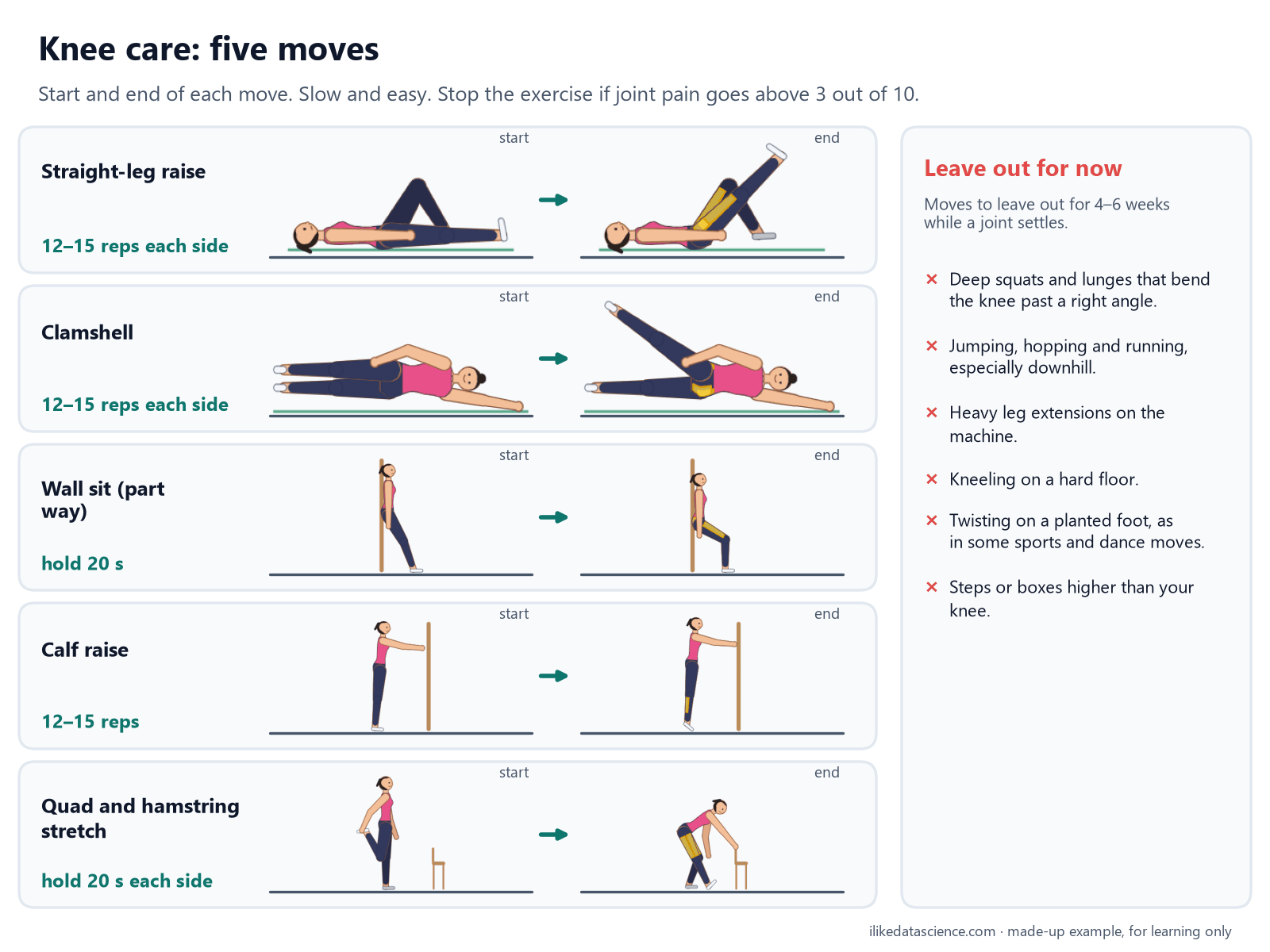
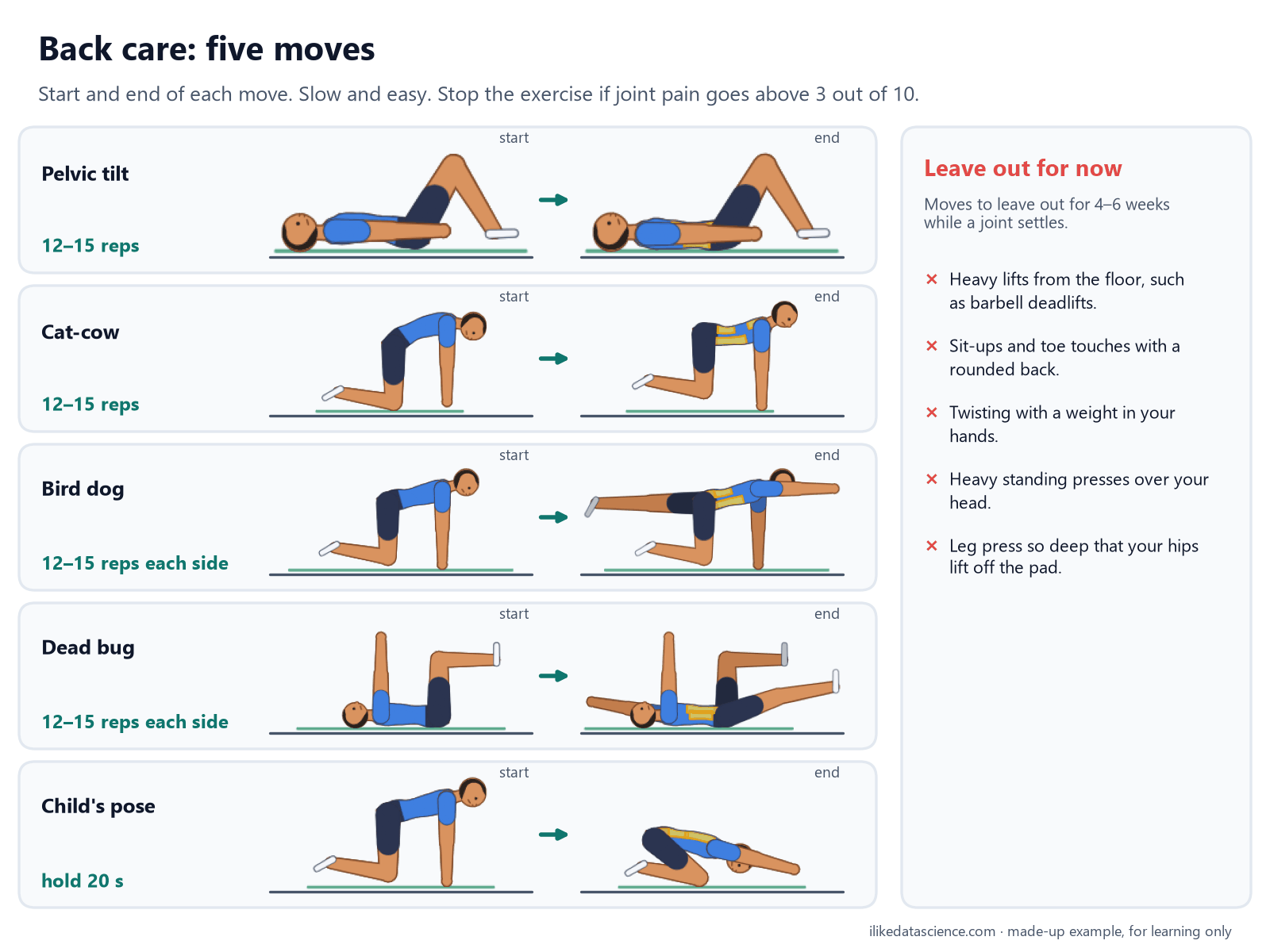
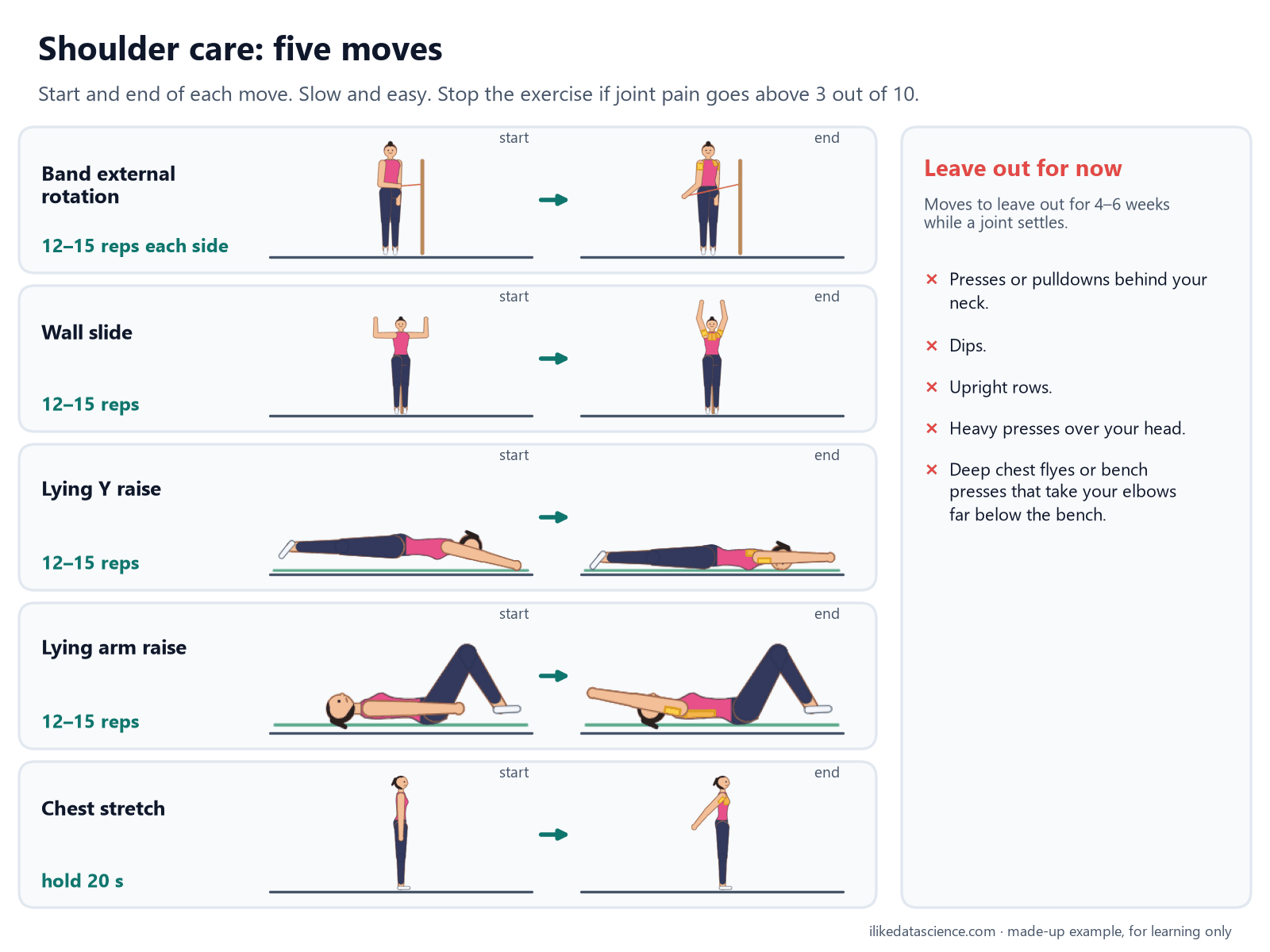
Leave these out for 4 to 6 weeks while a joint settles:
- Knee: deep squats and lunges, jumping and running, heavy leg extensions, kneeling on a hard floor, high steps.
- Back: heavy lifts from the floor, sit-ups with a rounded back, twisting with a weight, very deep leg press.
- Shoulder: presses or pulldowns behind your neck, dips, upright rows, heavy presses over your head.
Use the traffic light to tell normal muscle ache from joint pain:
Food, sleep and recovery #
Muscle grows when you rest and eat enough protein.
- Food: the woman's target is about 1,410 kcal and 73 g protein. The man's is about 1,680 kcal and 107 g. Spread protein over the day.
- Water: about 2.4 litres on rest days and 2.8 on gym days for her. About 2.7 and 3.1 litres for him. This counts water from food too.
- Sleep: aim for 7 to 9 hours. Short sleep makes you hungrier the next day.
- A missed week: it happens to everyone. Use a lighter weight for the first session back.
For meals, a plate and a full day of food, see Plan your diet for the man or the woman.
Notes for women and for men #
For women
- Your cycle: your energy can change from week to week. Train by feel. A lighter day is fine.
- Iron and bones: iron-rich foods like dal, greens and eggs help. Strength work keeps bones strong.
- Pregnancy and after birth: turn the plan off for now. A doctor or physiotherapist can guide you.
- Pelvic floor: breathe out as you lift. Leaking or heaviness is a reason to see a physiotherapist.
- Menopause: strength work protects your bones and muscle.
For men
- Belly fat: fat around the organs often builds first in men. It also tends to go down early.
- Brace and breathe: on heavier lifts, brace your belly and keep breathing.
- Hernia signs: a new bulge in the groin or belly, or pain there, is a reason to stop and see a doctor.
New lifters gain about 0.15 to 0.5 kg of muscle a month (women) or 0.25 to 0.75 kg (men). Gains are smaller while you eat less than you use.
Check in and adjust #
- Each week: weigh yourself on the same day, at the same time.
- Weeks 4, 8 and 12: scan again. Every 8 to 12 weeks after that.
- After a new scan: add it to the Trend tab. It draws your new scan against the plan line, so you can see if you're on track.
If you're behind, change one thing at a time. Then build the next plan from the new numbers.
Stay safe #
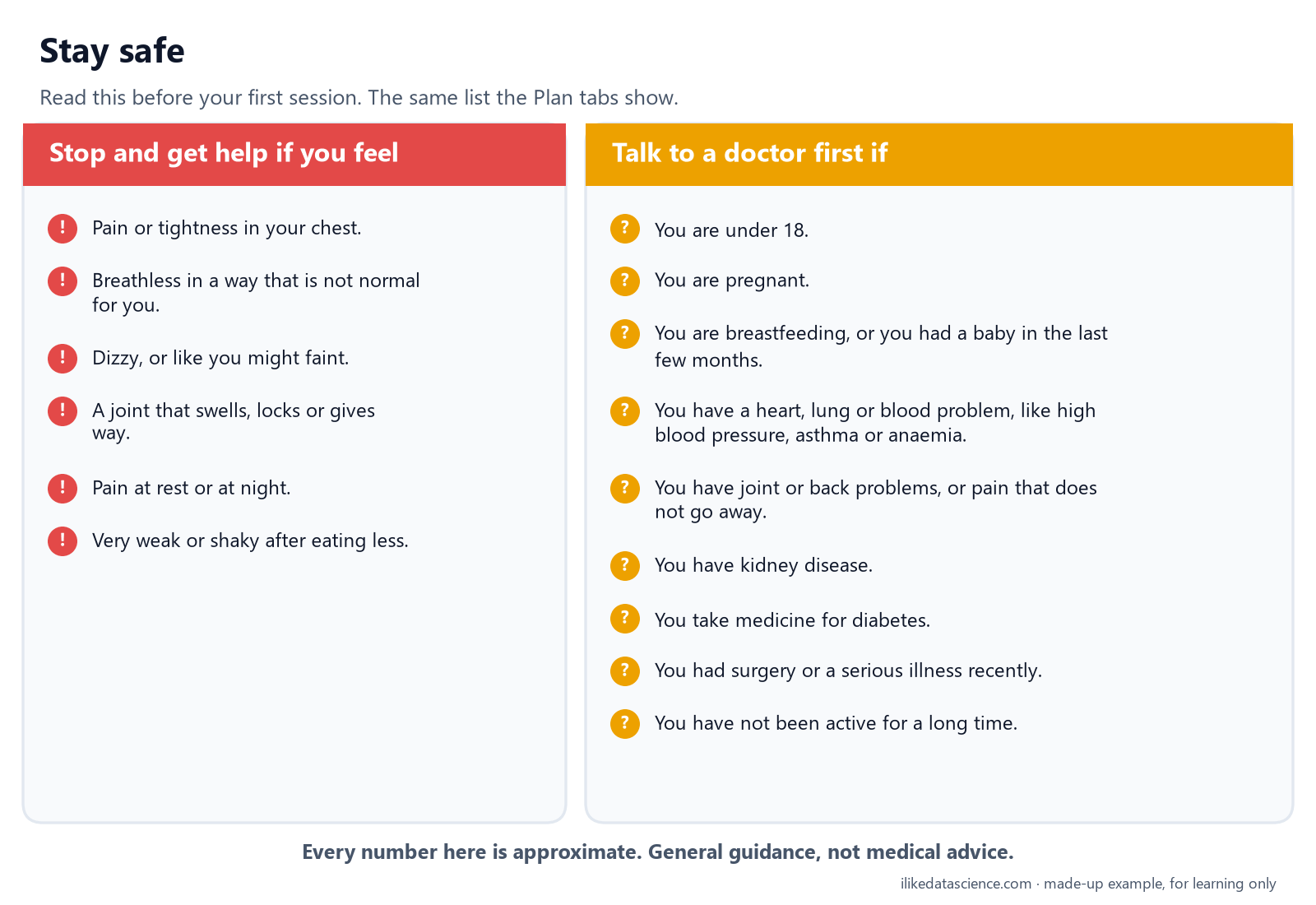
Stop and get help if you have chest pain, unusual breathlessness or dizziness. Stop if a joint swells, locks or gives way, or hurts at rest or at night.
Talk to a doctor first if you have heart, lung, blood, joint or back problems. Do the same if you're pregnant, had a baby recently, had surgery or illness lately, or haven't trained in a long time.
The calculator shows no numbers if you're under 18, pregnant or breastfeeding, have kidney disease, or take diabetes medicine. It never sets a calorie target below your BMR, or below 1,200 kcal (women) or 1,500 kcal (men), and 1,500 if you prefer not to say. The gap is never more than 25% of what you use, the pace never more than 1% of your weight a week, and there is no gap at all if your BMI is under 18.5.
Try it #
- The example man's plan: 4 days, upper and lower.
- The example woman's plan: 3 days, A and B.
- Your own plan, no scan needed: type your age, height and weight.
- Signed in? Open a saved scan and pick the Plan your training tab.
All the maths runs in your browser. This is general guidance for learning, not medical advice.
Questions? Get in touch.
Sources #
- Exercise steps: each move links its page above (ACE, NASM, Muscle & Strength).
- BMR: Cunningham 1991 (Katch–McArdle) and Mifflin 1990.
- Daily life factors: FAO/WHO/UNU 2004.
- Exercise effort (MET): 2024 Adult Compendium.
- 7,700 kcal per kg: Hall 2008.
- Deficit and pace limits: Murphy and Koehler 2022, Helms 2014, CDC.
- Calorie floors: Harvard Health.
- Protein: Morton 2018 and ISSN 2017.
- Water: EFSA 2010.
- Cardio and strength days: WHO 2020 guidelines.
- Muscle gain: Benito 2020 and Roberts 2020.
- Visceral fat level: InBody.
- Rest and reps in reserve: ACSM 2026 position stand.
Finished? Set your reading status:
Readers' comments 0
Comments from readers on highlighted passages. Each one is checked before it appears. Names aren't shown.