fMRI from zero: a 32-lesson path from beginner to expert
- fMRI
- Neuroscience
- Data Engineering
- Machine Learning
- Neuroimaging
The series hub · 32 lessons · beginner to expert
fMRI from zero is a series of short lessons about fMRI, the brain scan that tracks changes in blood oxygen. It starts with "what is fMRI?" and ends with you training your own fMRI classifier.
I wrote it for people who know data but not the brain. If you build pipelines or models and the physics and anatomy words get in the way, start here.
Who it is for
- Data engineers and data scientists who are starting work on fMRI data.
- Anyone who wants to know how a brain scan becomes data a model can use.
You need some Python for the later lessons. You don't need any physics or biology.
How each lesson works
Each lesson covers one idea and takes 5 to 10 minutes. They all follow the same shape:
- The one-sentence idea: what the lesson is about.
- Explain it simply: plain words, with an analogy from data engineering.
- Go one level deeper: the technical detail.
- A visual: a chart, a diagram or an animation.
- Why it matters for data analysis: where you will meet it in real datasets.
- Key terms: a short glossary.
- Check yourself: 3 questions, with answers.
- Go further: 1 to 3 trusted sources.
Each lesson ends with links to the previous lesson, this page and the next lesson.
Pictures you can play with
Some ideas are easier to see than to read. These pages let you switch the magnet on, fire a radio pulse or build a task, and watch what happens:
- Hydrogen and the MR signal: how the scanner gets a signal from water in the brain.
- Oxygen and the BOLD signal: why active brain areas look a little brighter.
- The haemodynamic response: why the signal arrives about 5 seconds late.
- Signal lost and recovered: how the signal fades, and how an echo brings part of it back.
More pages are added as the lessons come out. See them all at fMRI from zero: interactive pages.
The learning path
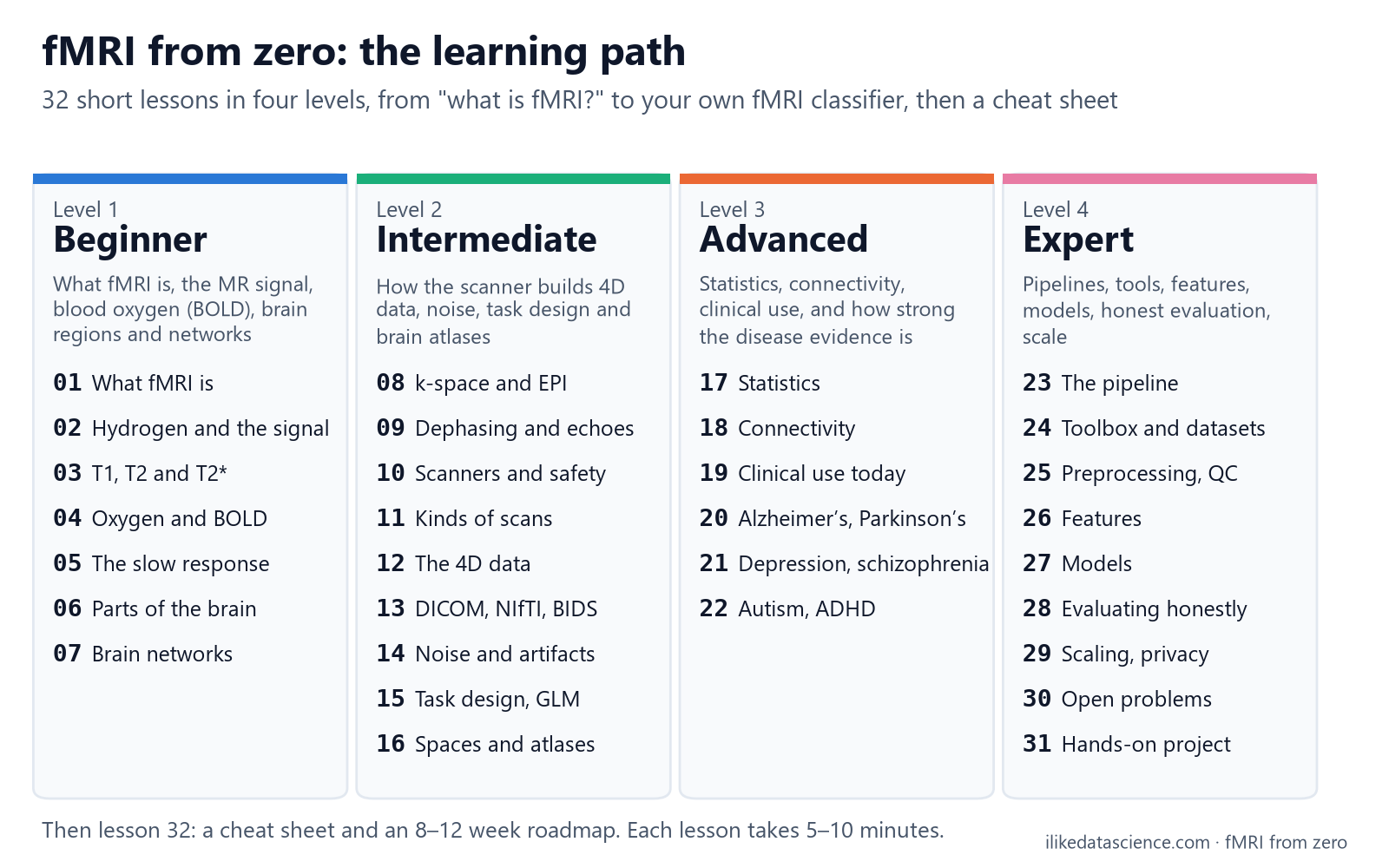
| Level | Lessons | At the end you can… |
|---|---|---|
| Beginner | 1–7 | Say what fMRI measures and why it is slow, and name the main brain regions and networks |
| Intermediate | 8–16 | Explain how a scan becomes a 4D file, where the noise comes from, and how a task is modelled |
| Advanced | 17–22 | Read a brain map without fooling yourself, and judge how strong a disease finding is |
| Expert | 23–31 | Build, test and scale an fMRI pipeline from end to end |
All lessons
New lessons are added level by level. A title becomes a link once its lesson is out.
Beginner
- What fMRI is, and what it isn't
- Hydrogen and the MR signal
- Relaxation: T1, T2 and T2*
- Oxygen and the BOLD signal
- The haemodynamic response: slow and delayed
- Parts of the brain: lobes and what they do
- Deep structures and the brain's networks
Intermediate
- How the scanner builds an image: gradients, k-space, EPI
- Signal lost and recovered: dephasing and echoes
- Scanners: field strength, coils, safety and limits
- Kinds of fMRI scans: task, resting-state, multiband, ASL
- The data: voxels, TR, TE, 4D, runs and sessions
- Files and BIDS: DICOM to NIfTI to BIDS
- Noise and artifacts
- Task design and the GLM
- Coordinate spaces and atlases
Advanced
- Statistics without fooling yourself
- Resting-state and functional connectivity
- Where fMRI is used in clinics today
- Alzheimer's, MCI and Parkinson's
- Depression and schizophrenia
- Autism and ADHD: big shared datasets, small effects
Expert
- The fMRI data pipeline from end to end
- The fMRI toolbox: libraries and open datasets
- Preprocessing and quality control in practice
- Features: from ROI time series to MVPA
- Models: from SVM to graph networks and foundation models
- Evaluating honestly
- Scaling fMRI data: storage, compute, versioning, privacy
- Open problems and where data engineers can help
- Hands-on: your first fMRI classifier with nilearn
Wrap-up
- Cheat sheet and an 8–12 week roadmap
How to use the series
- Go in order if fMRI is new to you. Each lesson builds on the ones before.
- Answer the 3 questions at the end of each lesson before you move on.
- Play with the pages. Change one thing at a time and watch what moves.
- Try the code. The expert lessons link to a starter project you can run on a laptop.
A note on accuracy
Health claims get special care. Each claim about a disorder is marked as established, supported or research / debated, with a source. Most fMRI disease prediction is still research.
The pictures are drawn by code from simulated data, unless a picture says it uses real data.
For learning only, not medical advice.
Start here: Lesson 1: What fMRI is, and what it isn't